💡What You'll Learn
- Why passwords alone are no longer sufficient for modern online security
- How AI-generated deepfakes and synthetic content are changing digital trust
- What decentralised identity means and how it gives users more control
- How blockchain can verify credentials without exposing personal data
- Why Australian businesses need to prepare for AI agents with delegated permissions
- Where businesses should start when rethinking their identity and authentication systems
Digital identity is rapidly becoming one of the most critical infrastructure challenges for Australian businesses, individuals, and governments in 2026.
The next era of the internet won’t just ask whether you know the password. It will ask whether you can prove who you are.
A few years ago, forgetting a password was one of the most annoying things about being online.
We’d click “Forgot Password”, wait for an email, reset it, and promise ourselves we’d remember it next time.
Then we’d forget it again.
We’ve become so used to passwords that we rarely question the system behind them.
But what if passwords were never the real problem?
What if the bigger problem is that the internet still doesn’t really know who we are?
It knows our usernames.
It knows our passwords.
It knows the information we give it.
But that’s very different from knowing whether a person is actually who they claim to be.
And as AI, deepfakes and digital fraud become more sophisticated, that distinction is becoming increasingly important.
Why Have We Built the Internet Around Accounts?
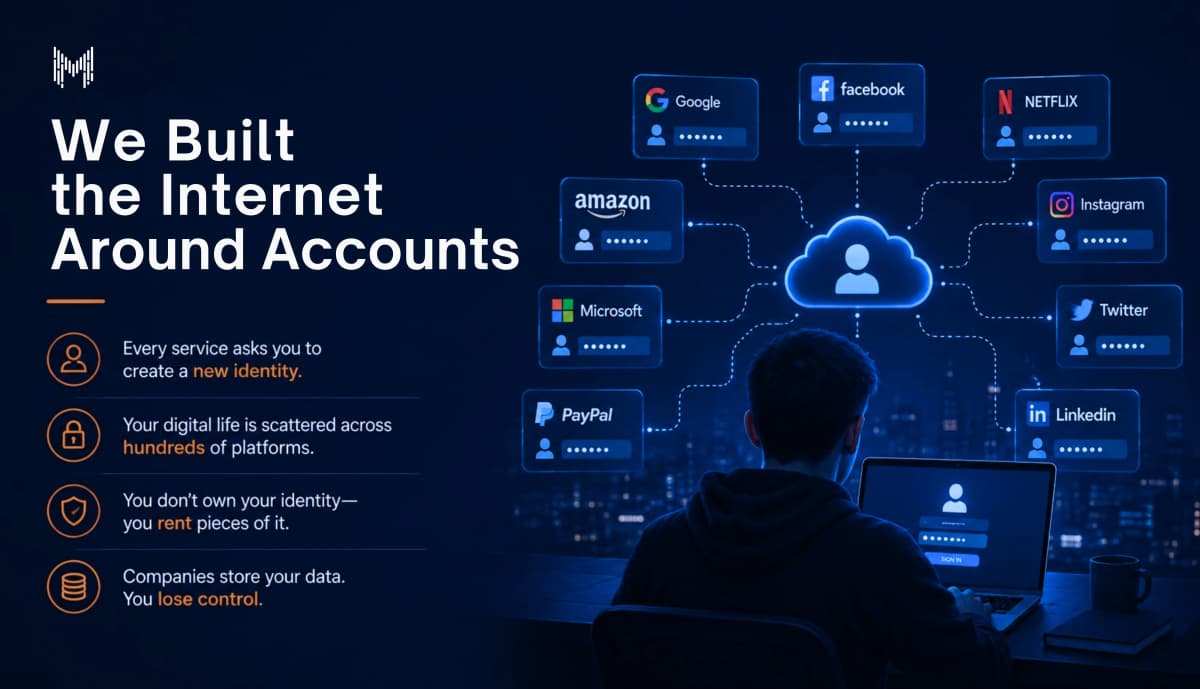
Think about how many accounts we have.
Email. Banking. Social media. Shopping. Streaming. Work platforms. Government services.
Every platform wants us to create another profile and another login.
We’ve ended up with pieces of our identity scattered across hundreds of databases.
Our digital lives are fragmented between companies, platforms and services we may never have a direct relationship with.
That model worked when the internet was simpler.
It becomes harder to manage when almost every part of our lives has a digital layer.
This is where digital identity becomes much more interesting than another conversation about passwords.
Why Were Passwords Never Built for Today’s Internet?
Passwords were designed for a world where we had relatively few digital accounts.
Now we’re constantly logging into something.
We’re working remotely, shopping online, accessing financial services, signing documents, using cloud platforms and interacting with AI tools.
We’ve also become increasingly dependent on digital services in cities such as Sydney, Melbourne and Brisbane.
The problem isn’t simply that passwords are inconvenient.
They’re also vulnerable to phishing, credential theft, data breaches and social engineering.
It’s why we help Australian organisations rethink authentication as part of our cyber security services, so trust online is built on more than a memorised string.
The Verizon Data Breach Investigations Report consistently identifies credential abuse as the leading initial attack vector in data breaches globally — reinforcing why passwords alone are no longer sufficient.
| Authentication Method | Security Level | User Friction | AI-Ready |
|---|---|---|---|
| Password only | Low | Low | No |
| Password + MFA | Medium | Medium | No |
| Passkey / Biometric | High | Low | Partial |
| Decentralised Identity | Very High | Low | Yes |
| Verifiable Credentials | Very High | Very Low | Yes |
How Has AI Made Digital Identity More Important?
Artificial intelligence has made an old problem much harder.
We can now generate realistic voices, images and videos.
A message from a colleague can be imitated.
A voice from a family member can be cloned.
A convincing photograph can be generated without a camera.
A phishing message can be written in seconds.
According to the ASD's Annual Cyber Threat Report 2024–25, Australia's cyber security centre received over 84,700 cybercrime reports in FY2024–25 — an average of one report every six minutes.
We’ve reached a point where seeing and hearing something isn’t always enough to prove it’s authentic.
So the question is changing.
It isn’t simply:
“Can you log in?”
It’s:
“Can you prove that you are really you?”
Why Is Your Digital Identity Becoming More Valuable Than a Password?
For years, we’ve treated identity as a login credential.
We may soon start treating it as something much bigger.
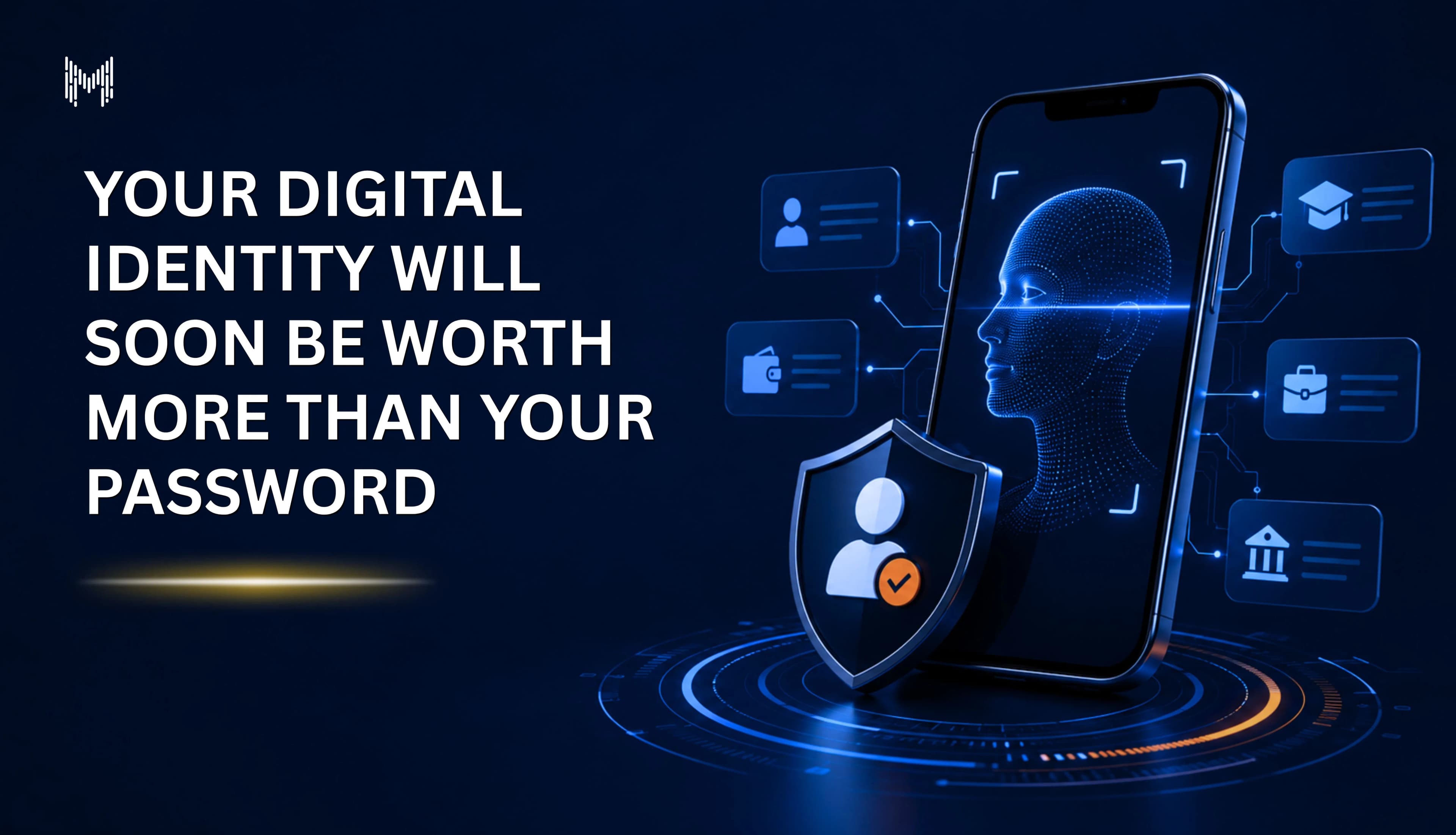
Imagine having a trusted digital identity that lets you prove specific facts about yourself without repeatedly handing over all your personal information.
- You could prove that you’re over 18 without revealing your exact date of birth.
- You could prove a qualification without emailing a scanned certificate.
- You could verify employment without giving someone access to your entire employment history.
- You could sign a digital agreement without creating another account.
The important shift is simple:
We prove what needs to be proven, without exposing everything else.
What Does a Passwordless Future Actually Mean for Online Trust?
Passkeys, biometrics and multi factor authentication are already changing how we authenticate.
But authentication answers a relatively narrow question:
“Can this person access the account?”
Digital identity can go further.
It can help answer:
- “Who is this person?”
- “What credentials do they have?”
- “What are they authorised to do?”
- “What information actually needs to be shared?”
That distinction matters enormously.
Especially when AI agents start acting on our behalf.
How Can Blockchain Support Digital Identity Without Storing Personal Data?
Blockchain is usually associated with cryptocurrency.
But one of its more interesting possibilities sits outside trading.
It could help create systems where digital credentials can be verified without relying entirely on a central authority.
This is one reason decentralised identity and verifiable credentials are attracting attention, and it’s an area our blockchain development team follows closely.
The idea isn’t to put everyone’s personal information on a blockchain.
It’s almost the opposite.
We can use cryptographic systems to verify information while limiting what gets exposed.
The W3C Verifiable Credentials Data Model defines the open standard that makes this possible — enabling cryptographically secure, privacy-respecting credentials that can be verified by any compliant system.
If these systems succeed, most people may never even notice that blockchain is involved.
That’s probably a good thing.
The best infrastructure tends to disappear into the background.
What Happens When AI Agents Need Their Own Digital Identity?
This is where things get really interesting.
We’re moving towards AI agents that can schedule meetings, analyse documents, make purchases and perform tasks for us - the kind of systems we build through our AI and machine learning services.
But how will another system know that an AI agent is actually authorised to act on our behalf?
Imagine an AI agent attempting to purchase something using your account.
A username and password aren’t enough.
The system needs to understand:
- Who authorised the action?
- What is the agent allowed to do?
- How much can it spend?
- When does its permission expire?
This creates an entirely new requirement for digital identity.
We won’t just need identities for people.
We’ll need trusted identities and permissions for machines acting on behalf of people.
Why Do Australian Businesses Need Stronger Digital Identity Systems?
We’ve traditionally thought about identity as a consumer issue.
It isn’t.
Businesses need to know whether employees, contractors, customers and systems are genuinely who they claim to be.
Consider a company operating across Sydney, Melbourne and Brisbane.
An employee may access financial systems from home.
A contractor may need temporary access to company data.
An AI agent may need permission to perform a routine task.
A customer may need to verify their identity remotely.
The Australian Government has already taken steps in this direction — Australia's Digital ID System, established under the Digital ID Act 2024, provides an accredited framework for secure digital identity verification across both public and private sectors.
The old model of simply handing out usernames and passwords doesn’t solve all of these problems.
Modern identity systems need to understand who someone is, what they can access and what they’re authorised to do.
How Can Digital Identity Be Powerful Without Becoming Invasive?
There is an obvious concern.
If digital identity becomes more powerful, could it also become more invasive?
It absolutely could.
That’s why privacy cannot be an afterthought.
A good identity system shouldn’t require us to reveal everything just because we need to prove one thing.
If we’re proving our age, why reveal our full date of birth?
If we’re proving a qualification, why hand over an entire personal file?
If we’re proving our identity to access a service, why should the service automatically receive information it doesn’t need?
The future of digital identity should be about sharing less while proving more.
Is the Next Internet Going to Be Built Around Identity and Trust?
We’ve already seen the internet evolve through several major stages.
The first web made information accessible.
Social platforms made participation easier.
Cloud computing made infrastructure more flexible.
AI is making intelligence increasingly accessible.
The next major shift could be about identity.
Who are you?
What can you prove?
What are you allowed to access?
What can you delegate to an AI?
And who gets to see your information?
These questions won’t remain limited to technology companies.
They will affect banks, retailers, governments, healthcare providers and businesses across Australia and beyond.
Will Passwords Disappear Completely?
We don’t expect passwords to vanish overnight.
Cash didn’t disappear when digital payments arrived.
Email didn’t disappear when messaging apps became popular.
Technology rarely replaces one system instantly.
Instead, the old system gradually becomes less important.
We’re likely to see passwords increasingly supplemented or replaced by passkeys, biometrics, multi factor authentication, verified credentials and other forms of digital identity.
The goal isn’t simply to make logging in easier.
It’s to make digital interactions more trustworthy.
The Most Valuable Thing You Carry May Not Be Your Wallet
For most of history, identity was physical.
A passport.
A driver’s licence.
A certificate.
A signature.
Now, more and more of our identity exists digitally.
Our reputation. Our qualifications. Our financial history. Our professional relationships. Our permissions. Our accounts. Our credentials.
As that value moves online, protecting identity becomes just as important as protecting money.
Perhaps even more important.
Because if someone steals your money, you can potentially replace it.
If someone compromises your identity, the consequences can follow you much further.
Where Should Australian Businesses Start with Digital Identity?
We’ve seen enough technology cycles to know that adoption shouldn’t begin with chasing the newest buzzword.
Businesses should start by asking practical questions.
- Where are we still relying on passwords?
- Where are identity checks creating friction?
- Which credentials could be verified digitally?
- Which systems need stronger authentication?
- And where could AI agents eventually require delegated permissions?
The organisations that answer these questions early will be better prepared for an internet where identity isn’t just something we use to log in.
It’s something we use to establish trust.
Why Choose Mkaits Technologies
At Mkaits Technologies, we help businesses in Sydney, Melbourne, Brisbane and across Australia prepare for an internet built around trust rather than passwords.
We design secure, privacy-first digital experiences that keep people in control of their own identity.
From cyber security and blockchain to intelligent automation, we build the infrastructure that modern identity depends on.
Explore our full range of services to see how we can help your organisation get ready.
Because in the next era of the internet, trust won’t be a feature.
It will be the foundation.
The Internet Is Moving From Passwords to Proof
We’ve spent decades building better ways to protect passwords.
The next decade may be about building better ways to prove identity.
And that shift matters.
Because AI is making it easier to imitate people.
Blockchain is creating new ways to verify information.
Digital services are becoming more deeply embedded in everyday life across Australia.
And businesses are increasingly relying on machines to act on our behalf.
In that world, simply knowing a password won’t be enough.
We will need trusted ways to prove who we are, what we own, what we can access and what we’re authorised to do.
Your password is a key.
Your digital identity is the person holding the key.
And as the internet becomes more automated, connected and intelligent, knowing who is on the other side of a digital interaction may become more valuable than the password itself.
For Australian businesses, the time to engage with these questions is now - not when a breach occurs or a regulation requires it.
Whether you are rethinking authentication, exploring blockchain-based verification, or preparing your systems for AI agents, Mkaits Technologies can help you build the infrastructure that modern identity depends on.
Explore our cyber security and blockchain development services to see where we can help.