

💡What You'll Learn
- Why smart contract security is critical
- How reentrancy attacks drain funds
- Common access control mistakes
- How MEV and front-running work
- Ways to prevent major vulnerabilities
If you’re building on Ethereum, security isn’t a feature it’s the foundation.
There’s a dangerous mindset in Web3 development.
It goes something like this:
“Let’s build the product first. We’ll handle security later.”
That works in Web2.
It does not work in Web3.
Because once a smart contract is deployed, it’s not just code anymore.
It’s live infrastructure.
It holds value.
And it’s exposed to anyone in the world.
No logins.
No permissions by default.
No undo button.
Just code… and consequences.
Why Smart Contract Security Matters More Than You Think
In traditional systems, if something breaks, you patch it.
In blockchain systems?
If something breaks, it gets exploited.
And not slowly.
Instantly.
Funds can be drained.
Logic can be abused.
Protocols can collapse.
That’s why smart contract security isn’t something you “add later.”
It’s something you build into every decision, every function, every line of code.
Let’s walk through the vulnerabilities every developer needs to understand.
1. Reentrancy: The Classic Attack
This is the one most developers hear about first.
And for good reason.
It’s one of the most damaging vulnerabilities in smart contract history.
What happens?
A contract sends funds to an external address before updating its internal state.
That external contract can call back into the original function…
Again.
And again.
And again.
Before the balance is updated.
Result?
Funds can be drained in a loop.
Why it happens:
Because of improper order of operations.
Developers trust external calls too early.
How to prevent it:
- Follow the checks-effects-interactions pattern
- Update state before making external calls
- Use reentrancy guards
2. Integer Overflow & Underflow : The Silent Break
Before Solidity 0.8, this was everywhere.
Numbers could “wrap around” silently.
Example:
- 255 + 1 = 0
- 0 - 1 = max value
That’s not just a bug.
That’s an exploit.
Isn’t this fixed now?
Yes… and no.
Solidity 0.8 introduced built-in checks.
But developers still introduce risks when they:
- use unchecked blocks
- write custom arithmetic logic
- integrate older contracts
The danger:
It doesn’t always crash.
Sometimes it just gives wrong results silently.
And that’s harder to detect.
3. Access Control Issues: The Most Common Mistake
This one is simple.
And that’s exactly why it’s dangerous.
A function that should be restricted…
Isn’t.
What this looks like:
- Missing onlyOwner modifier
- Incorrect role assignment
- Public functions exposing sensitive logic
Result?
Anyone can:
- change contract parameters
- withdraw funds
- take control of the system
Why it happens:
Developers focus on functionality.
And forget about who should be allowed to use it.
Fix:
- Always define roles clearly
- Use well-tested access control patterns
- Audit permissions like you audit logic

4. Front-Running (MEV Exploits) : The Invisible Race
Here’s something many developers underestimate.
Your transactions are not private.
They sit in a public mempool before being confirmed.
And bots are watching.
Constantly.
What happens?
A user submits a transaction.
A bot sees it.
The bot submits a similar transaction…
But with higher gas fees.
It gets executed first.
Result?
- Arbitrage opportunities stolen
- Trades manipulated
- Users get worse outcomes
This is called:
MEV (Maximal Extractable Value)
When you’re vulnerable:
- When logic depends on timing
- When order of execution matters
- When prices or state can be manipulated
Mitigation:
- Use commit-reveal schemes
- Design logic that doesn’t rely on transaction order
- Consider private transaction solutions
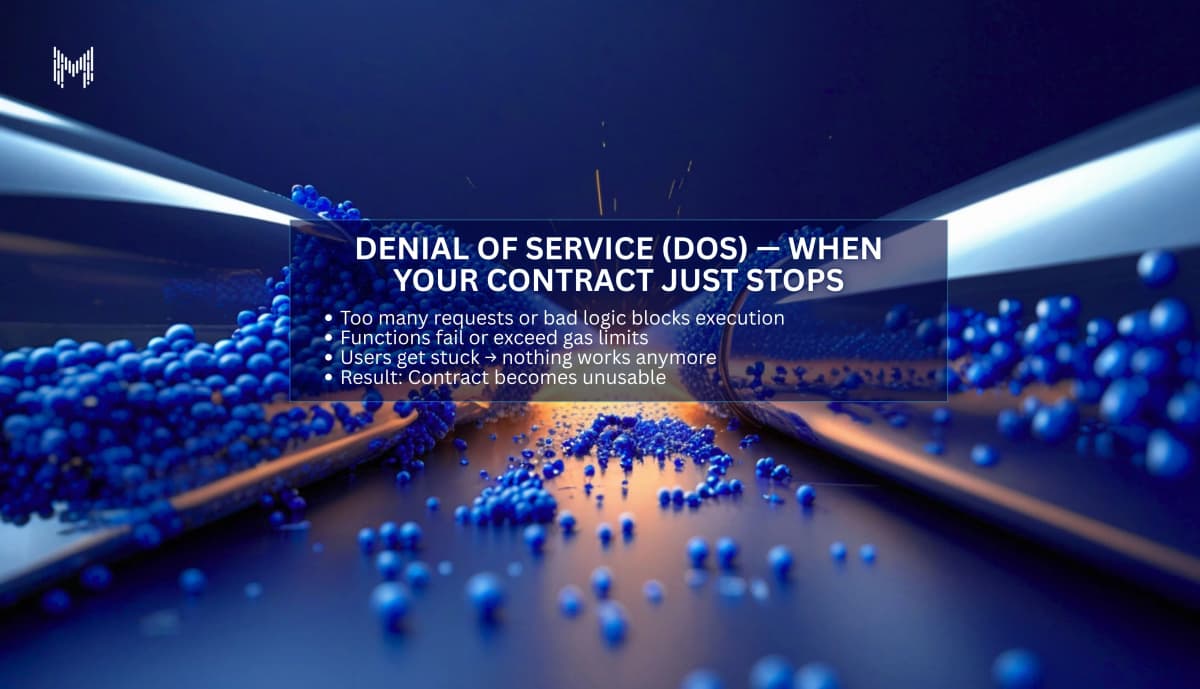
5. Denial of Service (DoS) : When Your Contract Just Stops
Sometimes the biggest failure isn’t exploitation.
It’s inoperability.
Your contract doesn’t get hacked.
It just… stops working.
Common causes:
- Loops that exceed gas limits
- External calls that fail and block execution
- State dependencies that break flows
What it looks like:
- Users can’t withdraw
- Functions fail repeatedly
- The contract becomes unusable
Why it’s dangerous:
Because it breaks trust.
Even without stolen funds.
Prevention:
- Avoid unbounded loops
- Handle failures gracefully
- Design for scalability and gas efficiency
The Real Shift: Think Like an Attacker
Most developers write code to make things work.
But secure developers think differently.
They ask:
“How can this break?”
“How can this be abused?”
“What happens if someone tries to exploit this?”
That mindset changes everything.
Because in Web3, you’re not just building features.
You’re building systems that people will try to attack.
Why This Matters Now More Than Ever
As blockchain adoption grows, so does the amount of value locked in smart contracts.
Which means:
More incentives to exploit.
More sophisticated attackers.
More pressure on developers to get it right.
Security is no longer optional.
It’s expected.
Why Choose Mkaits Technologies
At Mkaits Technologies, we don’t treat security as a final step.
We treat it as a core design principle.
Our approach includes:
- secure smart contract development
- thorough auditing practices
- vulnerability testing
- scalable blockchain architecture
Because in Web3, one mistake isn’t just a bug.
It’s a risk.