
💡What You'll Learn
- Why complexity kills curiosity and drives users away fast
- How to design Web3 products around outcomes, not features
- Why building only for power users blocks real adoption
- Why onboarding can’t fix a product that isn’t instantly clear
- How trust is built through clarity, not just cryptography
Web3 loves to position itself as a clean break from Web2.
New tech. New rules. New future.
But here’s the uncomfortable truth most teams avoid:
Web3 is repeating the same mistakes that killed thousands of Web2 products.
Just with wallets, tokens, and more complicated dashboards.
If we don’t talk about this honestly, decentralization won’t save anyone.
The Myth: “Web3 Is Different, So Old Lessons Don’t Apply”
Every generation of tech believes this.
Web2 teams once said:
- “Users will learn.”
- “The product is powerful, they just need time.”
- “Once adoption starts, everything will click.”
Sound familiar?
Web3 just replaced emails with wallets and logins with signatures
but the underlying mistakes stayed exactly the same.
Users didn’t disappear because of bad tech.
They disappeared because the products felt exhausting to use.
Web2 Didn’t Fail Because of Technology
Let’s be clear.
Most Web2 products didn’t die because:
- Servers couldn’t scale
- Features weren’t impressive
- Teams weren’t smart
They failed because:
- Nobody understood the value fast enough
- The experience felt confusing
- The product demanded effort before delivering value
The same thing is happening in Web3 only faster.
Lesson #1: Complexity Kills Curiosity
Web2 products failed the moment users felt stupid using them.
When people had to:
- Read documentation before trying
- Watch tutorials just to get started
- Ask support what a button does
They didn’t complain.
They left.
Web3 doubled down on this mistake.
Seed phrases.
Gas fees.
Network switching.
Wallet permissions.
Every step leaks users.
Curiosity dies when friction shows up too early.
Lesson #2: Features Don’t Create Value Outcomes Do
Web2 teams loved feature roadmaps.
More dashboards.
More toggles.
More customization.
Users didn’t care.
They wanted:
- One clear outcome
- One solved problem
- One obvious win
Web3 products still sell features instead of outcomes.
“Stake, bridge, wrap, sign, approve” means nothing to a real human.
If users can’t explain your product in one sentence, they won’t use it.

Lesson #3: “Power Users” Are Not the Market
Web2 products often died because teams built for insiders.
Early adopters.
Super users.
Internal teams.
Everyone else felt locked out.
Web3 made this worse by celebrating complexity as intelligence.
If your product only works for:
- Crypto Twitter
- Discord mods
- Engineers
- Traders
It’s not early.
It’s narrow.
Mass adoption doesn’t come from educating everyone.
It comes from removing reasons to quit.
Lesson #4: Onboarding Can’t Fix a Broken Product
Web2 teams tried to solve confusion with:
- Tooltips
- Walkthroughs
- Tutorials
It didn’t work.
Web3 copied the same playbook.
If your product needs a tutorial just to explain what it does, the problem isn’t onboarding.
The problem is clarity.
Great products don’t teach.
They reveal.
Lesson #5: Trust Is Emotional, Not Technical
Web2 companies lost users when people stopped trusting them.
Not because of code but because the experience felt risky, confusing, or stressful.
Web3 assumes cryptography = trust.
It doesn’t.
If users don’t understand:
- What they’re signing
- What happens after clicking
- What they can lose
They don’t feel safe even if the protocol is perfect.
Trust is built through clarity, not decentralization.
Why Web3 Products Lose Users Quietly
Here’s the scariest part.
Users don’t complain.
They don’t leave feedback.
They don’t ask questions.
They bounce.
No tweet.
No rage.
No explanation.
Just silence.
That’s exactly how Web2 products died slowly, quietly, invisibly.
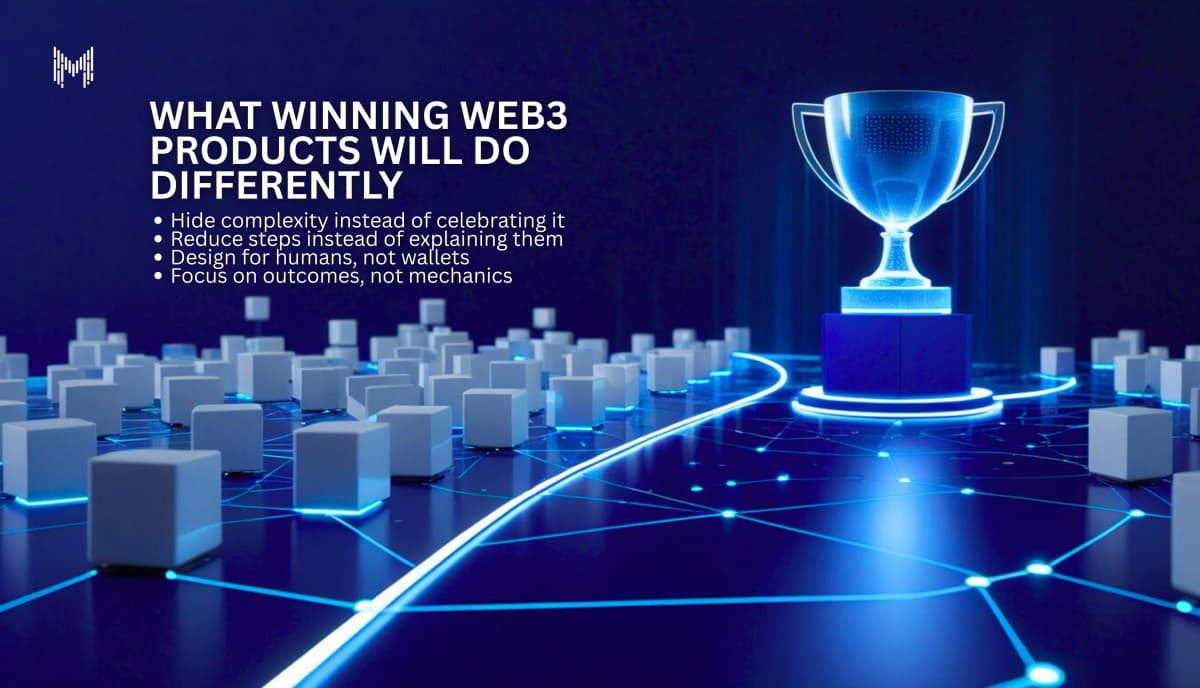
What Winning Web3 Products Will Do Differently
The next wave of successful Web3 products won’t look like Web3.
They will:
- Hide complexity instead of celebrating it
- Reduce steps instead of explaining them
- Design for humans, not wallets
- Focus on outcomes, not mechanics
They’ll feel obvious.
And that will make them controversial.
Because obvious doesn’t feel “innovative” Nbut it converts.
Why This Matters in 2026
By 2026:
- Infrastructure will be commoditized
- Protocols will look similar
- Tokens will be easier to launch
The only real advantage left will be experience.
Products that respect attention will win.
Products that demand effort will disappear.
Why Choose MKaits Technologies
At Mkaits Technologies, we don’t build for hype cycles.
We build for:
- Clarity over complexity
- User behavior over assumptions
- Products that make sense in seconds
Whether it’s Web3, DeFi, NFT platforms, or enterprise systems
our focus stays the same:
If users don’t understand it quickly, it doesn’t ship.
Because technology doesn’t fail products.
Confusion does.
Web3 doesn’t need to reinvent product fundamentals.
It needs to remember them.
The future won’t belong to the most decentralized product.
It will belong to the one people actually understand and use.
And history has already shown us what happens when we ignore that.