💡What You'll Learn
- Why vague prompts lead to generic AI output
- How AI reflects the clarity of your thinking
- The real reason AI feels uncreative or wrong
- Why constraints improve creativity and results
- How better prompting improves communication overall
Let’s be honest for a second.
Most people don’t have an AI problem.
They have a communication problem.
And AI is just exposing it.
Every day I see the same complaint online:
“AI doesn’t get what I want.”
“ChatGPT is giving generic answers.”
“AI isn’t creative anymore.”
“Why does it keep missing the point?”
But when you look at the prompt, it’s something like:
“Write something cool for my startup.”
That’s not a prompt.
That’s a thought bubble.
And then we act surprised when the output feels vague, shallow, or off-target.
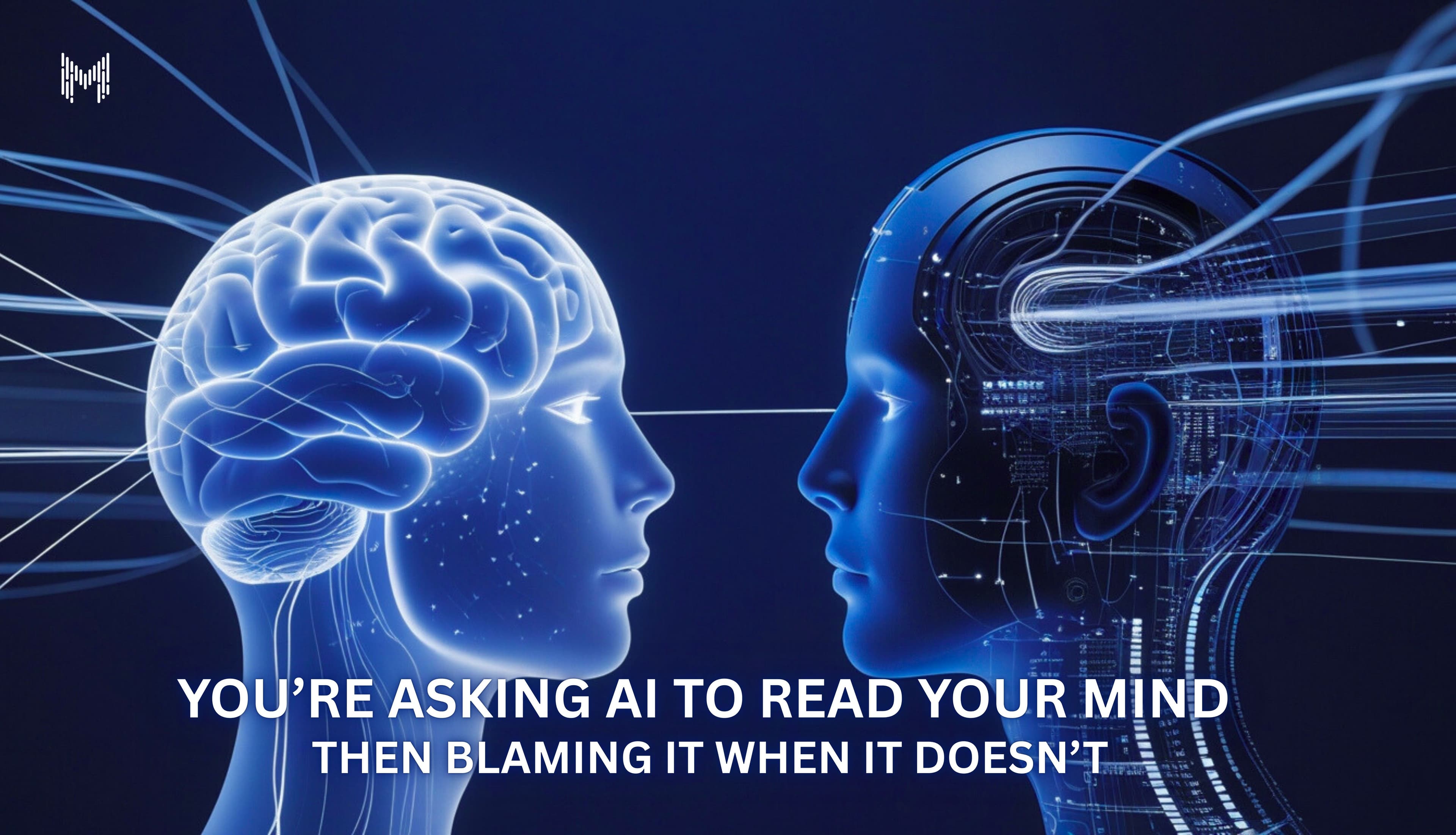
You’re not asking AI to write.
You’re asking it to read your mind.
The Uncomfortable Truth Nobody Wants to Hear
AI isn’t bad at understanding.
Humans are bad at explaining.
We carry context in our heads:
- What stage the startup is at
- Who the audience is
- What tone we like
- What we don’t want
- What we’re secretly hoping for
- Then we type one lazy sentence and expect magic.
That’s not intelligence.
That’s wishful thinking.
And when the result disappoints us, we blame the tool instead of the input.
Why AI Feels “Dumber” Than It Actually Is
AI doesn’t think like you.
It doesn’t infer intent.
It doesn’t “get the vibe” unless you define the vibe.
It works on clarity, structure, and constraints.
When you give it:
- No audience
- No goal
- No context
- No examples
- No boundaries
- It fills the gaps the only way it can: with averages.
That’s why outputs feel generic.
That’s why everything sounds the same.
That’s why people say, “AI writing has no soul.”
It’s not soulless.
It’s directionless.
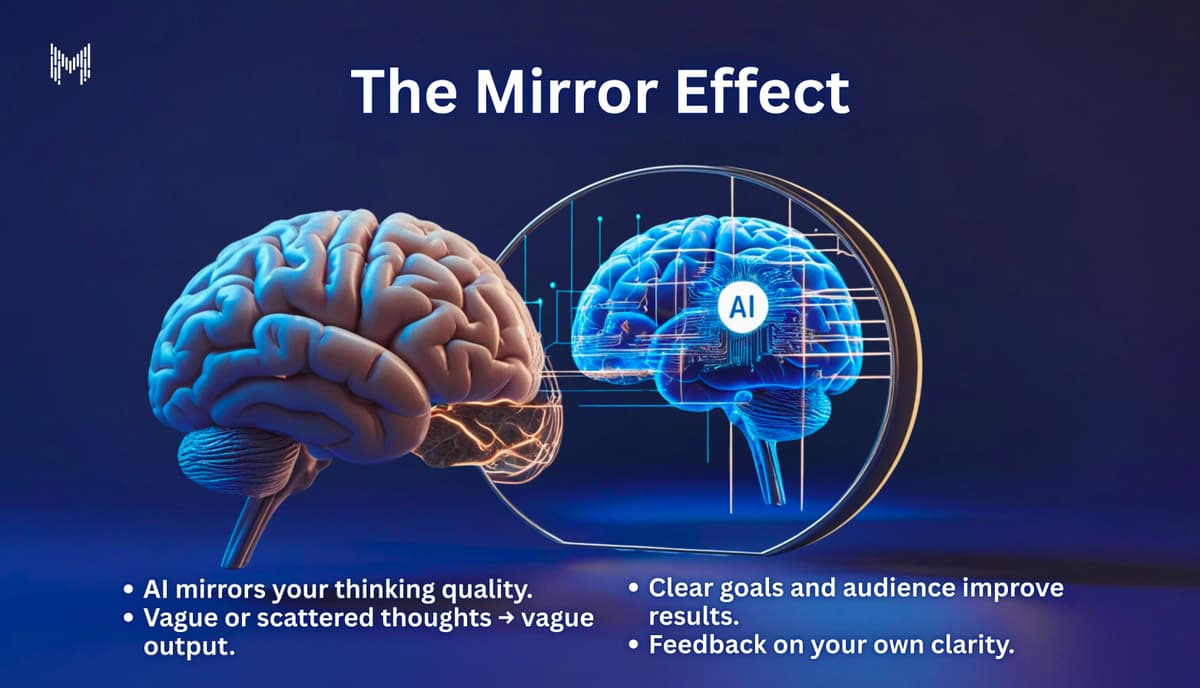
The Mirror Effect: AI Reflects How You Think
Here’s something most people don’t realize:
AI doesn’t just generate content.
It mirrors your thinking quality.
If your thoughts are:
- Scattered → output feels scattered
- Vague → output feels vague
- Conflicted → output feels confused
That’s not an AI failure.
That’s feedback.
The clearer you are about:
- What problem you’re solving
- Who you’re speaking to.
- What outcome you want.
- The better AI performs.
AI rewards intentional thinkers.
It exposes lazy ones.
Why “Just Be Creative” Never Works
Creativity isn’t randomness.
It’s constraint-driven exploration.
Humans forget this.
So we tell AI things like:
- “Be creative”
- “Make it viral”
- “Write something engaging”
- That’s like telling a designer: “Make it look nice.”
Nice how?
For whom?
In what context?
With what constraints?
Great creative work comes from clear limits, not infinite freedom.
AI is no different.
The Prompting Myth That’s Wasting Everyone’s Time
There’s a belief going around that “prompt engineering” is some elite skill.
It’s not.
Good prompting is just good thinking.
It’s:
- Breaking ideas down
- Making assumptions explicit
- Knowing what you want before asking for it
The same skills required to:
- Brief a designer
- Lead a team
- Explain a vision
- Build a product
- AI isn’t changing the game.
It’s revealing who actually understands their own ideas.

Why This Matters Beyond AI
This isn’t really about AI.
It’s about how people communicate in general.
Bad prompts are the same reason:
- Products launch unclear
- Clients feel misunderstood
- Teams ship the wrong thing
- Meetings go nowhere
- AI is just the fastest feedback loop we’ve ever had.
It doesn’t nod politely.
It doesn’t guess your intention.
It gives you exactly what you asked for nothing more.
And that’s uncomfortable.
The Shift That Changes Everything
The moment people stop asking:
“Why doesn’t AI understand me?”
And start asking:
“Am I being clear?”
Everything improves.
Your prompts get better.
Your thinking sharpens.
Your communication improves.
Your leadership gets stronger.
You stop outsourcing clarity.
You start earning better outputs.
How to Stop Asking AI to Read Your Mind
You don’t need fancy frameworks.
You need honesty.
Before prompting, ask yourself:
- What is the real goal here?
- Who is this for?
- What should the reader feel or do?
- What should not happen?
- Then tell the AI exactly that.
Not poetically. Not vaguely. Clearly.
AI doesn’t need inspiration.
The Irony Nobody Talks About
People worry AI will replace human thinking.
In reality, AI is forcing humans to think better.
It punishes ambiguity.
It rewards clarity.
It exposes weak reasoning.
And that’s why some people hate it.
Because for the first time, there’s no one else to blame.
If AI feels frustrating to you, don’t write it off yet.
Pause and look at the input.
Because most of the time, the problem isn’t that AI can’t understand you.
It’s that you haven’t fully understood what you’re trying to say yourself.
And AI is just holding up the mirror.